W6Mo5Cr4V2, W6Mo5Cr4V2Co5 and W2Mo9Cr4VCo8 are molybdenum high-speed steels that differ mainly in cobalt content. That single alloying addition is what you are really buying — and it is also what drives the cost difference.
Cobalt raises the temperature at which the steel keeps its hardness, which matters when a rotary die runs at several hundred revolutions per minute against abrasive board or film. It does not make the steel tougher; in fact it does the opposite. Getting the trade-off right is the whole selection exercise.
- W6Mo5Cr4V2 (JIS SKH51 / AISI M2)
- No cobalt, HRC 60-63
- W6Mo5Cr4V2Co5 (AISI M35)
- 5% cobalt, HRC 63-66
- W2Mo9Cr4VCo8 (AISI M42)
- 8% cobalt, HRC 65-66
- Typical die-grade delivery
- Hardened, ground, ±1 HRC
GB standard reference
- Standard
- GB/T 1299 (alloy tool steel) · GB/T 1220 (stainless)
- GB grades in this article
- W6Mo5Cr4V2 · W6Mo5Cr4V2Co5 · W2Mo9Cr4VCo8
- Also sold as
- M2 / SKH51 · M35 / SKH55 · M42 / SKH59
- Hardness range
- HRC 60-63 · HRC 63-66 · HRC 65-66
1. What Cobalt Buys You — and What It Costs
Cobalt dissolves in the matrix and raises the tempering temperature the steel can survive. Practically, that means a die made from W2Mo9Cr4VCo8 keeps its cutting edge at a temperature where an W6Mo5Cr4V2 die has already started to soften. It buys red hardness, wear resistance and heat resistance. What it takes away is toughness and grindability.
| Property | W6Mo5Cr4V2 | W6Mo5Cr4V2Co5 (5% Co) | W2Mo9Cr4VCo8 (8% Co) |
|---|---|---|---|
| Working hardness | HRC 60-63 | HRC 63-66 | HRC 65-66 |
| Red hardness (edge temp. limit) | ~540 °C | ~590 °C | ~620 °C |
| Toughness | Best | Medium | Lowest |
| Grindability | Best | Medium | Hardest |
| Relative material cost | Baseline | +30-45% | +70-100% |
| Best fit | General die cutting | Long-run board dies | Abrasive film & thick board |
Upgrading a die to W2Mo9Cr4VCo8 does not automatically extend life. If the failure mode is chipping rather than wear, the extra hardness will shorten life — the edge has less capacity to absorb impact.
2. Heat Treatment Differences That Matter
All three grades are austenitized high and tempered multiple times, but cobalt grades need tighter control because their hardening window is narrower and their tolerance for overheating is lower.
| Parameter | W6Mo5Cr4V2 | W6Mo5Cr4V2Co5 | W2Mo9Cr4VCo8 |
|---|---|---|---|
| Preheat | 550 °C / 850 °C | 550 °C / 850 °C | 550 °C / 850 °C |
| Austenitizing | 1190-1220 °C | 1190-1210 °C | 1170-1190 °C |
| Quench | 6-10 bar N₂ | 6-10 bar N₂ | 6-10 bar N₂ |
| Tempering | 3 × 550 °C | 3 × 550 °C | 3 × 540-560 °C |
| Result | HRC 62-64 | HRC 64-66 | HRC 65-67 |
High-speed steel retains more austenite than cold-work steel after quenching. Three tempers are the standard for W6Mo5Cr4V2, W6Mo5Cr4V2Co5 and W2Mo9Cr4VCo8; two leaves retained austenite that will move during wire-EDM or in service.
3. Matching the Grade to the Die Type
This matrix reflects the failure mode we see on each die family in production:
| Rotary die application | Recommended grade | Hardness | Why |
|---|---|---|---|
| Label kiss-cutting, standard speed | W6Mo5Cr4V2 | HRC 60-62 | Toughness protects the fine tooth roots |
| Solid die, long label and board runs | W6Mo5Cr4V2Co5 | HRC 63-65 | Edge temperature is the limiting factor |
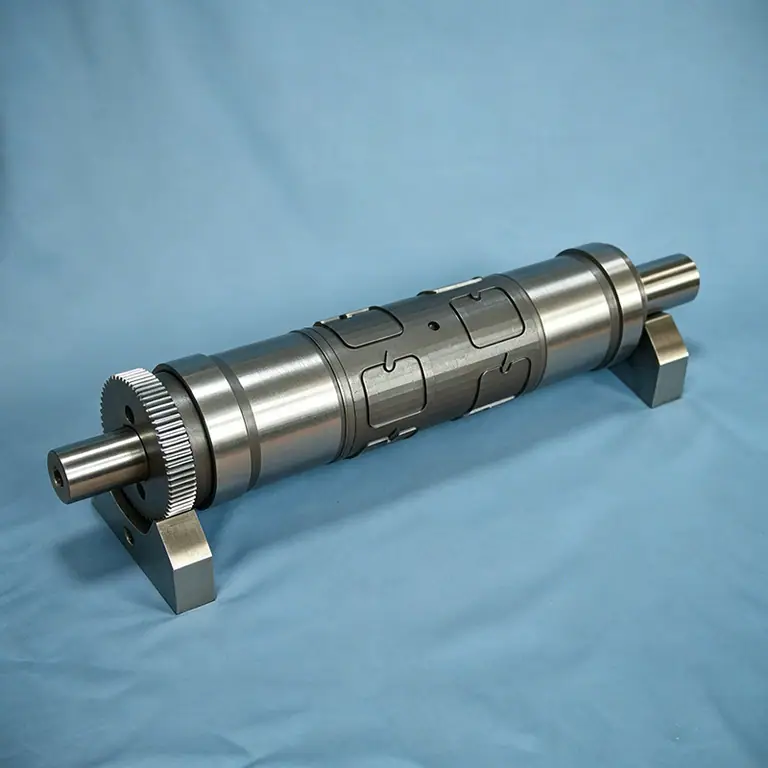
| Segmented dies for corrugated board | W6Mo5Cr4V2Co5 / W2Mo9Cr4VCo8 | HRC 63-66 | Segments carry impact load; body is reused |
| Film and foil slitting (abrasive) | W2Mo9Cr4VCo8 / PM23 | HRC 65-66 | Abrasive web at high edge speed |
| Fine-pitch contours that micro-chip | PM23 | HRC 64-65 | Carbides ≤3 µm — no chipping initiation sites |
| Economy dies, low line speed | Cr12Mo1V1 | HRC 58-62 | Cost-driven, robust geometry only |
4. Cost Case: When the Premium Pays
Work through a realistic example. A label cutting die in W6Mo5Cr4V2 runs 400,000 linear metres between re-sharpens at a material cost of X. The same die in W6Mo5Cr4V2Co5 might reach 700,000 metres at 1.4X material cost. If the die change itself costs four hours of press downtime, the W6Mo5Cr4V2Co5 upgrade is justified on the first cycle. If instead the die is replaced because of a chip at 200,000 metres, no upgrade helps — the problem is die design or die-cutting pressure, not steel grade.
- Upgrade the grade when the failure mode is gradual edge wear
- Do not upgrade when the failure mode is chipping, cracking or plate damage
- Quantify changeover cost before choosing — it usually dominates material cost
- Above W2Mo9Cr4VCo8, the next real step is powder metallurgy steel such as PM23, not more cobalt
High-speed steel rotary dies: frequently asked questions
W6Mo5Cr4V2Co5 adds about 5% cobalt to the W6Mo5Cr4V2 base composition. That raises red hardness and wear resistance so the edge survives higher cutting temperatures, allowing HRC 63-66 instead of HRC 60-63. The trade-offs are lower toughness, harder grinding and 30-45% higher material cost.