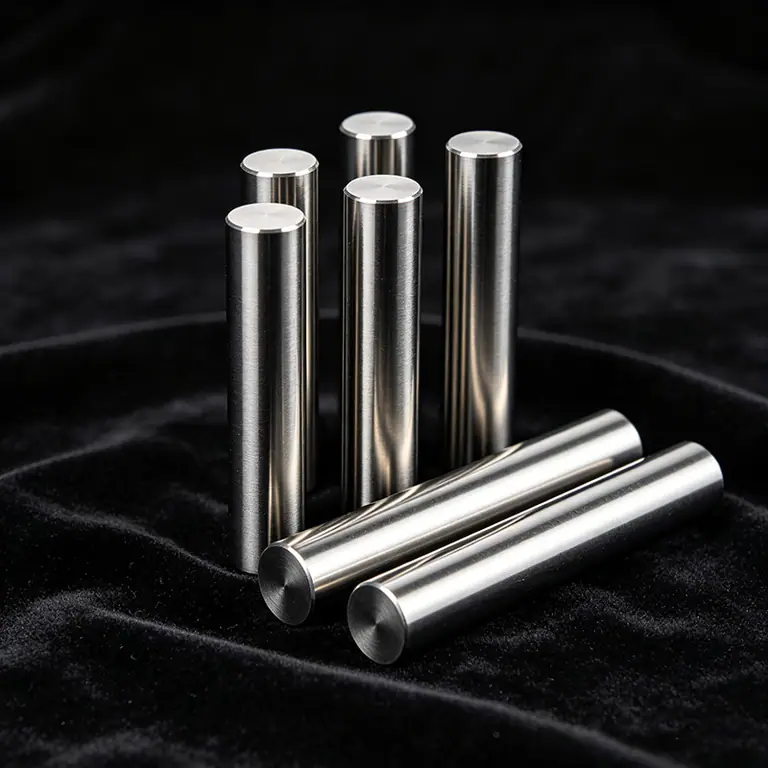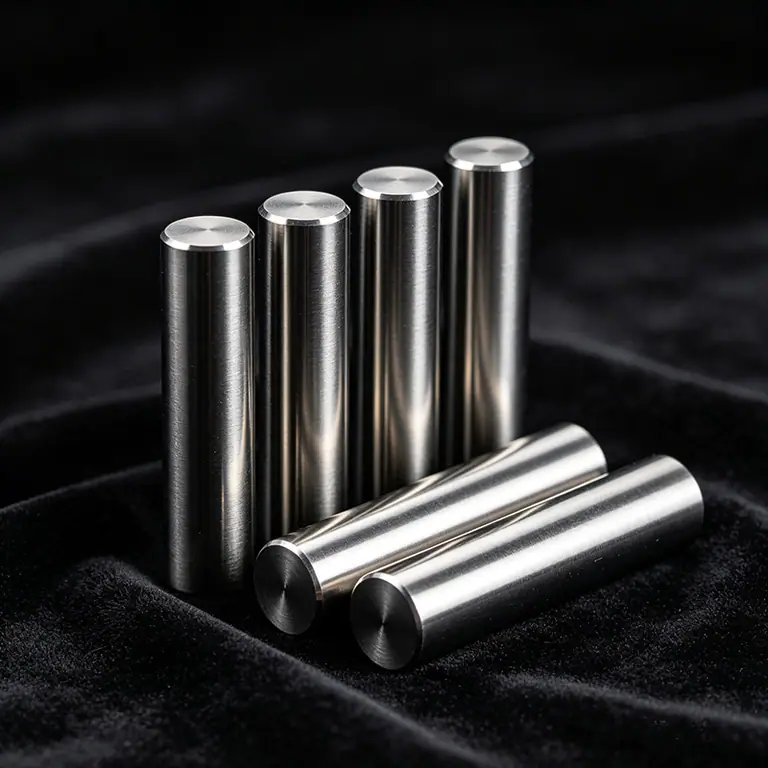
Almost every incoming enquiry quotes a different standard: a Japanese SKD11 drawing from one customer, a German 1.2379 from another, an AISI D2 from a third, and a Russian Kh12MF from a fourth. They frequently describe the same bar. This chart maps every grade we stock against the eight designation systems our customers actually use.
No two national standards define a grade identically. Carbon and alloy ranges overlap but rarely coincide, and permitted residuals differ. Use this chart to work out which of our grades your drawing is asking for — then confirm the chemistry and the heat treatment against the standard your drawing actually cites. Never substitute on the strength of a cross-reference alone.
GB standard reference
- Standard
- GB/T 1299 (alloy tool steel) · GB/T 1220 (stainless)
- GB grades in this article
- All 9 stocked grades
- Also sold as
- GB designations are our product names; JIS, AISI/ASTM, DIN, BS, NF, UNI and GOST designations are listed as references
- Hardness range
- HRC 50-66 across the range
1. How to Read This Chart
Every grade we stock is one row, and the five international standards sit on the same line so you can compare across the whole range without jumping between tables: ISO 4957:2018, ASTM A681-24, JIS G4404, DIN EN ISO 4957 and GOST 5950-2000, against our own GB designations in the first column. A dash is not a gap in our data — it means that standard publishes no designation for the grade, and the notes below the table explain each one.
- Grades covered
- 11 stocked grades
- Standard systems
- GB, AISI/ASTM, JIS, DIN/W-Nr, BS, NF, UNI, GOST
- Delivery form
- Ground hardened bar, Φ2 - Φ100 mm
- Verification
- Spectral analysis against the cited standard
- Order route
- Quote against any designation in the chart
2. The Cross-Reference Table: Five Standards Side by Side
| Grade (GB) | ISO 4957:2018 | ASTM A681-24 | JIS G4404 | DIN EN ISO 4957 | GOST 5950-2000 |
|---|---|---|---|---|---|
| 9Cr18Mo | — | 440C / S44004 | SUS440C | X105CrMo17 / 1.4125 | 95Kh18 |
| 30Cr13 | — | 420 / S42000 | SUS420J2 | X30Cr13 / 1.4028 | 40Kh13 |
| Cr8Mo2SiV | — | D2 mod | SKD11 mod | — | — |
| Cr12Mo1V1 | X153CrMoV12 | D2 / T30402 | SKD11 | X153CrMoV12 / 1.2379 | Kh12MF |
| Cr12MoV (D3, not stocked) | — | D3 / T30403 | SKD3 | 1.2601 (withdrawn) | Kh12M |
| 9CrWMn | — | O1 / T31501 | SKS3 | 95MnWCr5 / 1.2510 | 9KhVG |
| W6Mo5Cr4V2 | HS6-5-2 | M2 / T11302 | SKH51 | HS6-5-2 / 1.3343 | R6M5 |
| W6Mo5Cr4V2Co5 | HS6-5-2-5 | M35 / T11335 | SKH55 | HS6-5-2-5 / 1.3243 | R6M5K5 |
| W2Mo9Cr4VCo8 | HS2-9-1-8 | M42 / T11342 | SKH59 | HS2-9-1-8 / 1.3247 | — |
| PM23 | HS6-5-3 | PM M3:2 | — | HS6-5-3 / 1.3344 | — |
The editions behind that table are the ones current at the time of writing: ISO 4957:2018 for tool steels, ASTM A681-24, JIS G4404, DIN EN ISO 4957:2018, GOST 5950-2000, and GB/T 1299 — our own grade names in the first column are the GB designations, which is why there is no separate GB column. UNS numbers such as S44004 and T30402 are the unified numbering system identifiers; procurement systems often carry those instead of the trade name, so they are worth quoting back when a purchase order arrives with an unfamiliar code.
DIN 17350 was withdrawn and replaced by DIN EN ISO 4957, so for most of these grades the German designation is now the ISO designation — X153CrMoV12 is both, and HS6-5-2 is both. Only the W-Nr stays German-specific, which is why 1.2379 appears in the DIN column and not the ISO one. If a drawing quotes 1.2379, the current answer is X153CrMoV12.
Cr12MoV is the one row where the takeover changed the answer. The old DIN 17350 symbol was X165CrMoV12 under W-Nr 1.2601, and that pairing is still printed in a great deal of supplier literature. But 1.2601 did not carry across into EN ISO 4957, and its chemistry sits outside the X210Cr12 class that the current standard does list for D3 — higher molybdenum and vanadium, lower carbon. So there is no current ISO or EN designation for this grade. Quote it as GB Cr12MoV with AISI D3 and JIS SKD3 as the nearest relatives, and compare chemistry rather than symbols.
Australia has no column because AS publishes no tool steel grade standard — AS 1444 covers wrought alloy steels with H-series hardenability. Australian drawings for these grades cite the ASTM designations instead. If a supplier offers you an "AS grade" for SKD11, D2 or SKH51, ask which standard number it comes from, because there is no such designation to quote.
Other cells are blank for the same reason, and each means something specific. The two martensitic stainless grades are not tool steels: 9Cr18Mo and 30Cr13 sit under the stainless bar standards, EN 10088-3 and ASTM A276, so the tool steel columns correctly have no entry for them. 9CrWMn has no ISO symbol either — EN ISO 4957 leaves the 1.2510 composition out, and 95MnWCr5 is a separate ISO grade that suppliers attach to it as a near-equivalent. Cr8Mo2SiV is a proprietary grade with no national designation in any system. PM23 is powder metallurgy — ISO and DIN recognise the HS6-5-3 composition class, but no standard lists it by trade name, because ASP is a registered trade mark rather than a grade designation.
3. Cold Work Tool Steels: The Hard Cases
Cold work tool steels are where cross-references cause the most damage, because the grades look similar on a certificate and behave very differently in a press.
3.1 Cr12Mo1V1 (SKD11, D2, 1.2379) — one steel, three names
SKD11 under JIS G4404 and D2 under ASTM A681 describe the same high-chromium cold work tool steel: roughly 1.40-1.60% carbon, 11-13% chromium, with molybdenum and vanadium balanced for toughness. The German 1.2379 (X153CrMoV12), French Z160CDV12, Italian X155CrVMo12-1, British BD2 and Russian Kh12MF all sit in the same family. If a drawing says D2 and a supplier offers SKD11, that is a genuine equivalent — but the working hardness range is not identical, so confirm the target before hardening.
3.2 Cr12MoV is not D2 — and never was
This is the single most common mis-cross-reference in Chinese die shops. Cr12MoV carries higher carbon at 1.45-1.70% and is properly equivalent to AISI D3, JIS SKD3, French Z200C12 and Russian Kh12M. The German number is 1.2601, but DIN 17350 was withdrawn and that number was not carried into EN ISO 4957, so no current ISO or EN symbol covers this composition — which is exactly why suppliers keep printing the old X165CrMoV12 beside it. It buys wear resistance at the cost of toughness, and substituting it for D2 or SKD11 produces a die that chips where the original would have survived.
The two are not interchangeable and the difference appears as edge chipping on thin profiles, usually within the first few thousand strokes. Ask for the spectral analysis report and check carbon and chromium against the standard your drawing cites.
3.3 Cr8Mo2SiV (DC53) has no equivalent anywhere
DC53 is a Daido Steel proprietary grade. It is often written as D2 modified or 1.2379 modified, and those descriptions are honest as far as they go — it is a SKD11 derivative with carbon and chromium reduced and molybdenum and vanadium increased — but there is no GB, BS, NF, UNI or GOST designation for it. Treat any cross-reference you are offered as an approximation and compare the actual chemistry.
4. Martensitic Stainless: 9Cr18Mo and 30Cr13
The two stainless grades sit at opposite ends of the hardness range and are frequently confused because both are described as 420-series or 440-series stainless.
440C carries around 1.0% carbon with 16-18% chromium and reaches HRC 58-62. Its equivalents are SUS440C in Japan, 1.4125 (X105CrMo17) in Germany, X105CrMo17 in Italy, Z100CD17 in France and 95Kh18 in Russia. It is the grade to specify when you need both corrosion resistance and genuine wear resistance.
SUS420J2 is a much lower-carbon stainless at 0.26-0.40% carbon and 12-14% chromium, reaching HRC 50-55. It maps to AISI 420, DIN 1.4028 (X30Cr13), British 420S45, French Z30C13, Italian X30Cr13 and Russian 40Kh13. Choose it for food-contact and wet-service cutting where 440C would be over-specified and a carbon tool steel would corrode.
5. High Speed Steels: W6Mo5Cr4V2, W6Mo5Cr4V2Co5, W2Mo9Cr4VCo8 and PM23
The high speed steels are the most internationally harmonised group, because ISO 4957 short names were adopted widely across Europe and Russia. M2 is HS6-5-2, M35 is HS6-5-2-5 and M42 is HS2-9-1-8; those three strings work unchanged in DIN, NF, UNI and, for M2 and M35, GOST as well.
ASP23 is different again. It is a powder metallurgy grade, and no national standard publishes a designation for it. The nearest published descriptions are PM M3:2 by alloy class and DIN 1.3344 / HS6-5-3 by composition. Specify it by the powder-metallurgy route and the chemistry, not by a standard number.
6. How to Order Against a Foreign Standard
Send the designation exactly as it appears on your drawing, together with the standard number if you have it — BS 4659, JIS G4404, ASTM A681, DIN EN ISO 4957, GOST 5950 or the GB equivalent. We will map it to the grade we hold, quote against it, and issue a spectral analysis report that confirms the delivered chemistry against the standard you cited rather than against our own description.
Where we believe the cross-reference is genuinely unsafe — the Cr12MoV-for-D2 case above is the usual one — we will say so before quoting rather than after the die fails.
Steel grade cross-reference: frequently asked questions
Yes, for practical purposes. JIS SKD11 and AISI D2 describe the same high-chromium cold work tool steel at roughly 1.40-1.60% carbon and 11-13% chromium — we stock it as Cr12Mo1V1 and Cr12Mo1V1. The German 1.2379 (X153CrMoV12), French Z160CDV12, Italian X155CrVMo12-1, British BD2 and Russian Kh12MF sit in the same family. The recommended working hardness is not word-for-word identical between the standards, so confirm the target HRC before hardening.
Send us the grade code exactly as your drawing prints it. We will tell you which of our eleven stocked grades it corresponds to, what the real differences are, and whether the substitution is safe for your application.