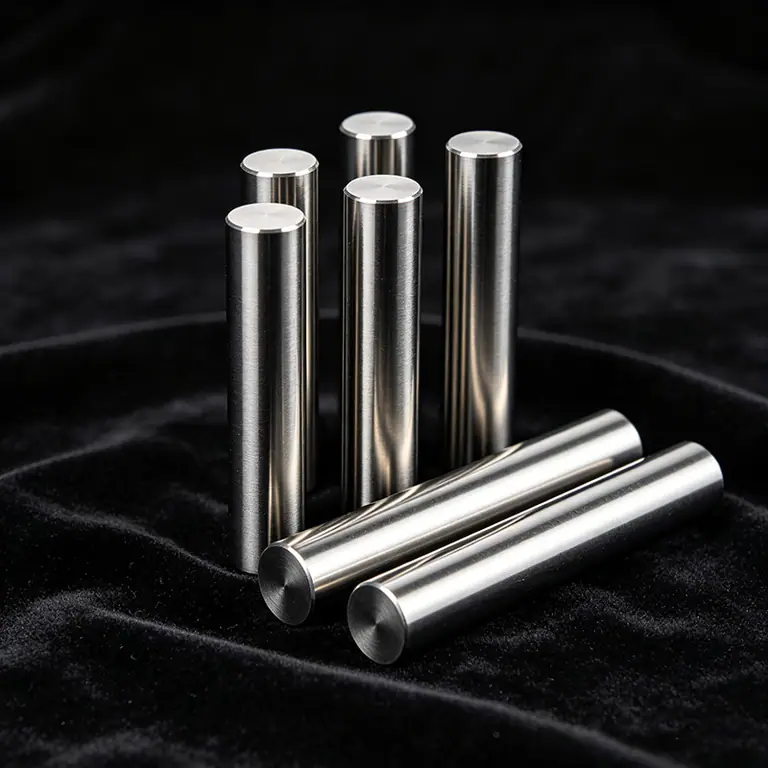
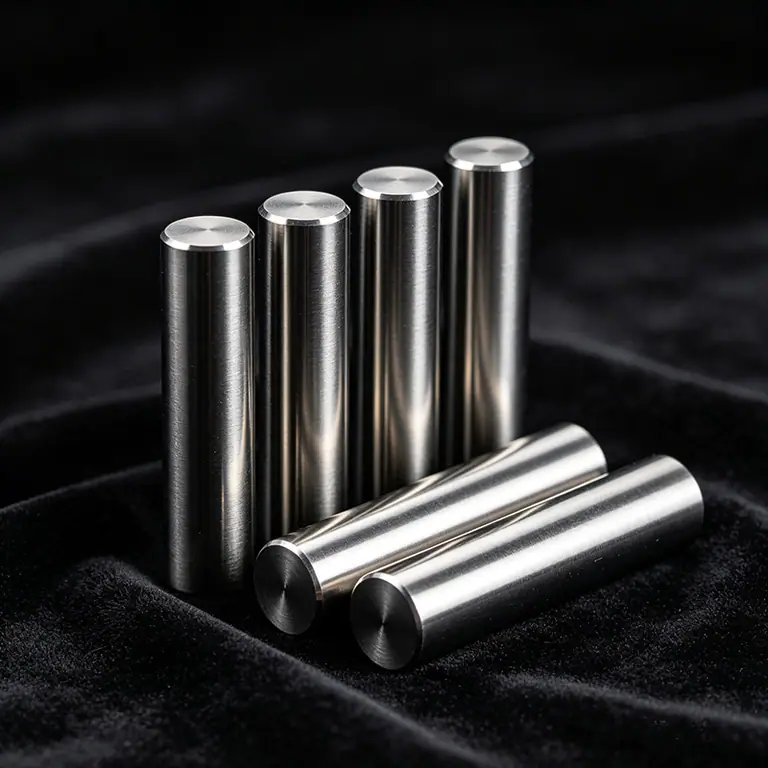
Heat treatment decides whether a die lives 50,000 strokes or 500,000. Vacuum processing is how you remove the variables — no oxygen, no decarburization, no scale, and a hardness profile you can actually certify.
In die and tool manufacturing, heat treatment is the decisive step for final performance. Conventional salt-bath and atmosphere furnaces are low in cost but prone to oxidation, decarburization and distortion. Vacuum heat treatment — the mainstream modern process — eliminates these problems at the source.
GB standard reference
- Standard
- GB/T 1299 (alloy tool steel) · GB/T 1220 (stainless)
- GB grades in this article
- Cr8Mo2SiV · Cr12Mo1V1 · W6Mo5Cr4V2
- Also sold as
- DC53 · SKD11 / D2 · M2
- Hardness range
- HRC 58-66 across the grades covered
1. How Vacuum Heat Treatment Works
Vacuum heat treatment heats and cools the work in an environment below atmospheric pressure. By evacuating the chamber, the oxygen level is extremely low, preventing the metal from reacting with oxygen at high temperature. The result is bright heat treatment — no oxidation and no decarburization.
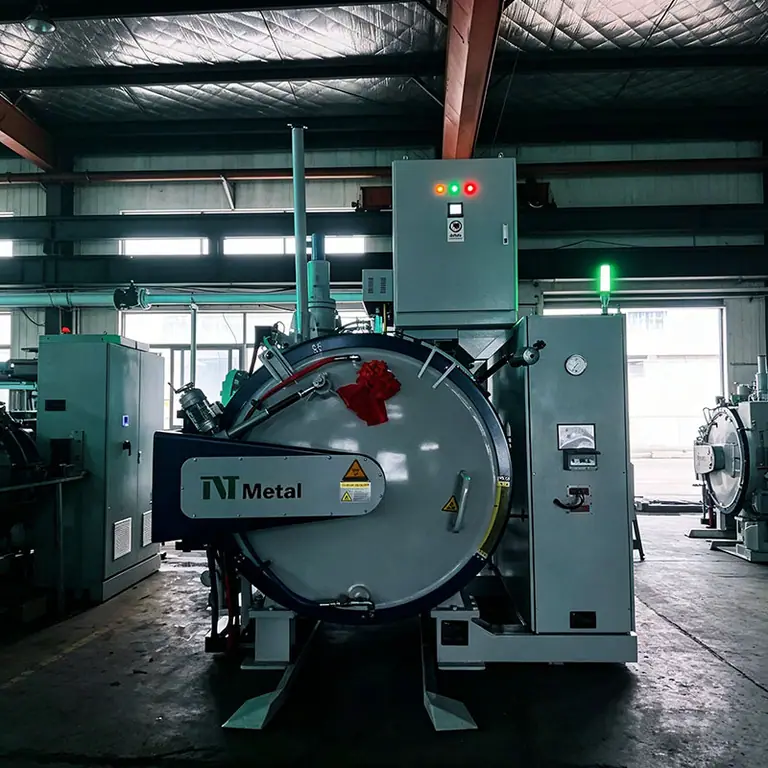
- Working vacuum level
- 0.1 - 1 Pa
- Quench medium
- High-purity nitrogen (N₂)
- Quench pressure
- up to 10 bar
- Max part size
- Φ2-Φ100 mm × 800 mm
- Decarburization achieved
- ≤ 0.05 mm
- Hardness tolerance
- ±1 HRC along the bar
1.1 How vacuum level affects results
The chamber vacuum level directly determines heat-treat quality. At different pressures, different reactions occur to different degrees:
| Pressure (Pa) | Residual Gas | Main Effect | Suitable Materials |
|---|---|---|---|
| 10⁵-10³ | Mostly air | Slight oxidation | Not recommended |
| 10³-1 | Mostly water vapor | Essentially no oxidation | Carbon steel |
| 1-10⁻¹ | Trace oxygen | No oxidation, no decarburization | Alloy steel |
| 10⁻¹-10⁻³ | Negligible | Bright heat treatment | Tool steel, stainless steel |
Vacuum heat treatment for die tooling runs at 0.1-1 Pa, guaranteeing no oxidation, no decarburization and a bright surface.
2. Gas Quenching vs Oil Quenching
Vacuum furnaces quench mainly by gas or by oil. Die steels are usually gas-quenched with high-purity nitrogen: distortion is small, surfaces stay clean and no post-cleaning is needed.
| Criterion | Gas quench (N₂) | Oil quench |
|---|---|---|
| Distortion | Low (0.02-0.05%) | Higher (0.05-0.15%) |
| Surface after quench | Bright, ready to use | Oily, must be cleaned |
| Cooling rate | Moderate — 10 bar closes the gap | Fast |
| Suitable sections | Up to ~Φ100 mm with 10 bar | Large sections, low-hardenability grades |
| Environmental load | None | Quench oil mist and disposal |
2.1 High-pressure gas quenching
Modern vacuum furnaces quench with high-pressure nitrogen or helium at 6-10 bar, achieving cooling rates close to oil quenching while keeping all the benefits of gas quenching. For cold-work tool steels such as Cr8Mo2SiV and Cr12Mo1V1, 10 bar high-pressure gas quenching delivers HRC 60-62.
3. Anatomy of a Typical Process Cycle
Take vacuum heat treatment of Cr8Mo2SiV round bar: the complete cycle consists of preheating, quenching and tempering, each stage under strict time-temperature control.
- 1First preheat (500-550 °C): relieves machining stresses and reduces distortion
- 2Second preheat (800-850 °C): minimizes the core-to-surface temperature gap before quenching
- 3Austenitizing (1020-1040 °C): soak for 20-25 min
- 4High-pressure gas quench (10 bar N₂): rapid cooling to room temperature to form martensite
- 5First temper (180-200 °C): relieves quenching stress and develops secondary hardness
- 6Second temper (180-200 °C): fully transforms retained austenite and stabilizes dimensions
Parts must cool to room temperature between the two tempers. Otherwise retained austenite transformation is incomplete, compromising final hardness and dimensional stability.
4. Impact on Die Performance
Compared with conventional heat treatment, vacuum processing improves die performance on several fronts:
| Indicator | Conventional Salt Bath | Vacuum Furnace | Improvement |
|---|---|---|---|
| Surface decarburization layer | 0.1-0.3 mm | ≤ 0.05 mm | ↓ 80% |
| Hardness uniformity | ±2-3 HRC | ±1 HRC | ↑ 50% |
| Distortion | 0.05-0.15% | 0.02-0.05% | ↓ 60% |
| Surface brightness | Black / blued | Bright as-new | Markedly better |
4.1 What decarburization actually costs you
A decarburized skin is soft. On a die-cutting rule the soft layer cannot hold an edge, so the first few thousand strokes polish it away and the edge geometry changes. Buyers who quote a decarburized bar often grind 0.1-0.3 mm off the diameter to reach sound metal — which is why a ≤0.05 mm layer is worth paying for.
Vacuum heat treatment is not a luxury for die tooling — it is a necessity. The extra cost pays back through longer die life and far lower rework rates.
Vacuum heat treatment: frequently asked questions
No. Vacuum hardening is a thermal process — it changes microstructure and hardness, not chemistry. In fact the vacuum environment prevents the surface chemistry changes (decarburization) that a salt bath or atmosphere furnace can introduce.
Nanfoss operates multiple 10 bar high-pressure vacuum gas-quench furnaces, handling round bar from Φ2 to Φ100 mm and up to 800 mm long. Contact our engineering team for specifications and process plans.